

Building in Historic Madison, GA
Madison, Georgia, is celebrated for its antebellum architecture, rich history, and scenic landscapes throughout Morgan County. For those building a new home or undertaking a major renovation in areas not serviced by municipal sewer lines, a new septic tank installation is a foundational step in the construction process. Proper installation is critical; it dictates the longevity, efficiency, and environmental compliance of your wastewater management for decades to come.
As the premier septic company in Madison, GA, Foy Septic specializes in comprehensive septic tank installations. We understand that the red clay soils of Morgan County present unique challenges that require expert assessment and precise engineering. This guide will walk you through the entire installation process, from initial site evaluation to the final inspection.
The Crucial First Step: The Soil Perk Test
Before a shovel even touches the ground, a thorough site evaluation must be conducted. The most critical component of this evaluation is the percolation test, commonly known as a “perk test.”
A perk test measures the rate at which water drains through the soil on your property. In Madison, the dense Georgia red clay can sometimes exhibit slow drainage rates, which heavily influences the design of the septic system. If the soil drains too slowly, the effluent will pool on the surface. If it drains too quickly, the wastewater may not be adequately treated before reaching the groundwater table.
Based on the perk test results and a deep hole test (to determine the depth of the seasonal high water table and bedrock), a certified environmental health specialist will design a system specifically tailored to your lot’s unique geological profile.
Navigating Permits and Regulations in Morgan County
Septic tank installations are heavily regulated to protect public health and the environment. In Madison and the greater Morgan County area, you cannot install a septic system without the appropriate permits from the local health department.
Foy Septic handles this administrative burden for our clients. We submit the detailed system design, lot layout, and perk test results to the Morgan County Environmental Health Department. They will review the plans to ensure they meet all local and state codes, including strict setback requirements from property lines, private wells, bodies of water, and building foundations.
Choosing the Right Septic System Design
Not all septic systems are created equal. Depending on your lot’s topography, soil conditions, and the size of your home, several different types of systems might be recommended:
1. Conventional System
This is the most common type of system, consisting of a standard septic tank and a gravity-fed gravel trench drain field. It is cost-effective and highly reliable, provided the soil conditions are suitable.
2. Chamber System
An alternative to gravel systems, chamber systems use large plastic chambers in the drain field trenches. They often require a smaller footprint and are excellent in areas where gravel is difficult to source, or where high groundwater tables are an issue.
3. Aerobic Treatment Unit (ATU)
If your property has poor soil, a high water table, or limited space, an ATU may be required. These systems use oxygen to break down organic matter much faster and more efficiently than a standard anaerobic tank, producing cleaner effluent. While more expensive to install and maintain, they are sometimes the only viable option for challenging lots.
The Installation Process with Foy Septic
Once permits are secured and the design is finalized, the actual installation begins. Foy Septic utilizes heavy machinery and precision techniques to ensure every component is perfectly placed.
- Excavation: The site for the tank and the drain field trenches are carefully excavated, adhering strictly to the engineered design depths and slopes.
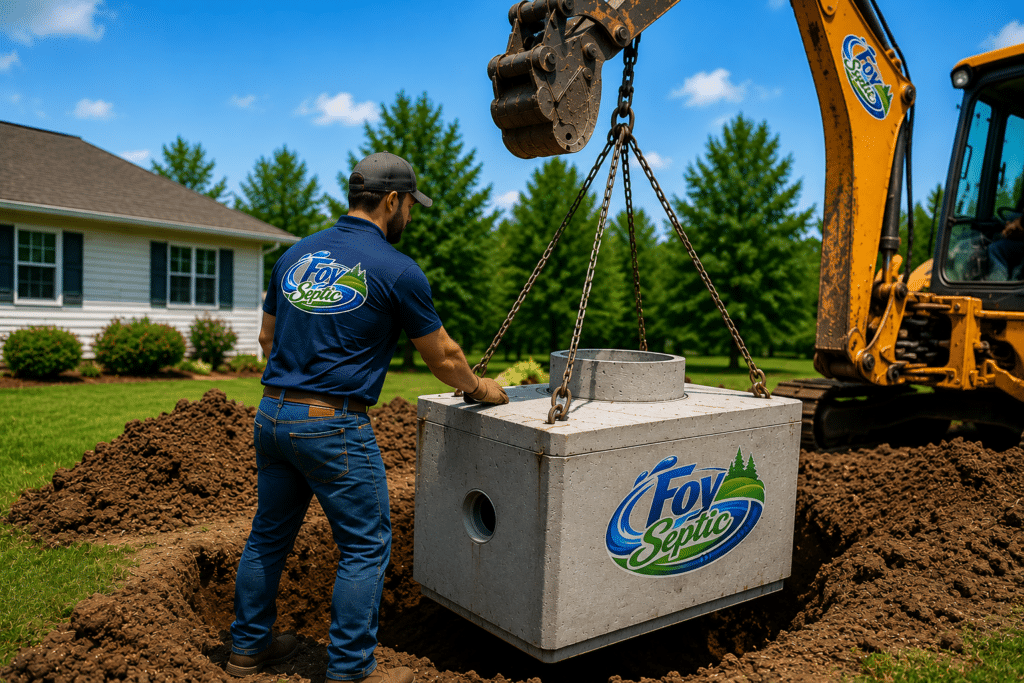
- Tank Placement: The septic tank (typically concrete, fiberglass, or high-density polyethylene) is lowered into the excavation. It must be perfectly leveled to ensure proper flow dynamics.
- Piping and Connections: Watertight pipes are run from the house to the tank, and from the tank to the distribution box and drain field. The slope (pitch) of these pipes is critical for gravity-fed systems.
- Drain Field Construction: Trenches are filled with the specified media (gravel, chambers, etc.) and perforated piping. A permeable fabric is often laid over the gravel to prevent dirt from clogging the system during backfilling.
Quality Assurance: Before any trenches are backfilled, a local health department inspector must visit the site to conduct a final inspection, ensuring the installation perfectly matches the permitted design.
Post-Installation: Landscaping and Care
After the system is approved and the site is backfilled, careful landscaping is required. The soil over the drain field should be slightly mounded to allow for settling and to encourage surface water runoff. Only shallow-rooted grasses should be planted over the system to prevent erosion without risking root intrusion. Once established, remember that routine septic tank pumping in Madison, GA will be required to keep your newly installed system running perfectly. Furthermore, proper maintenance is the only way to ensure you never have to deal with a devastating sewage backup in Madison, GA.
Planning a build in Madison, GA? Trust the experts at Foy Septic for a seamless, compliant, and durable septic tank installation. Contact us today to discuss your project and schedule a site evaluation.